
HCOOH CH2 H2O: Structure, Reactions, and Industrial Applications
HCOOH CH2 H2O: Structure, Properties, and Key Uses
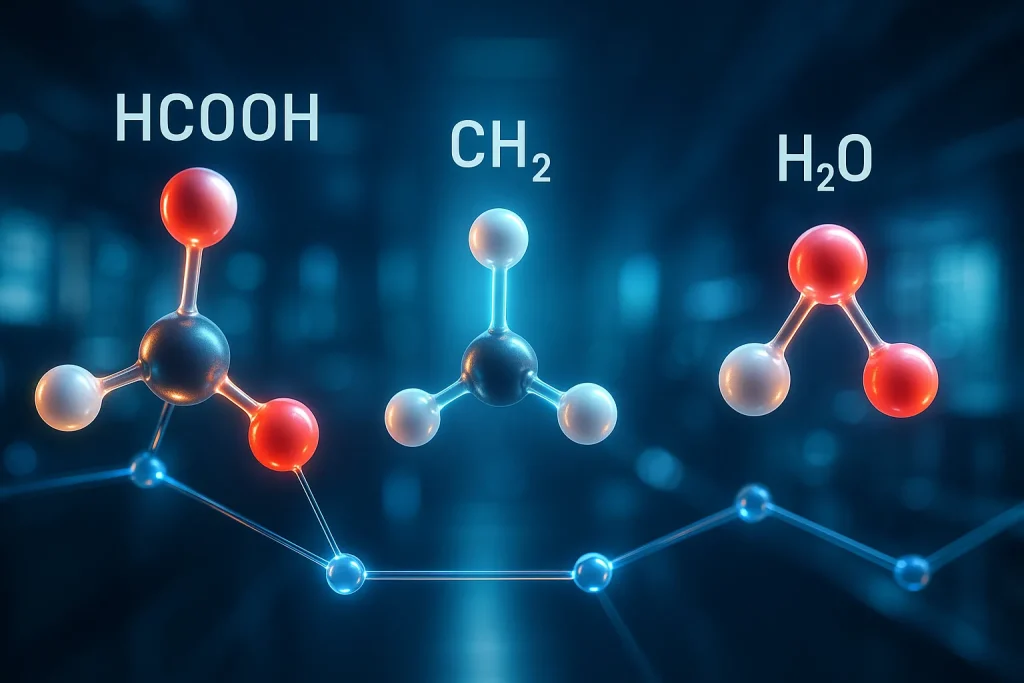
Behind the formula HCOOH CH2 H2O lies not a single molecule, but a powerful chemical trio often seen together in laboratories and industries:
- HCOOH (Formic Acid) – the simplest carboxylic acid.
- CH2 (Methylene) – a vital carbon unit in organic chemistry.
- H2O (Water) – the universal solvent of life and science.
Together, these components fuel critical processes in polymer chemistry, esterification, hydrolysis, hydrogen storage, and green energy research. Let’s break down their structures, properties, and real-world applications.
Breaking Down the Components of HCOOH CH2 H2O
🔬 Formic Acid (HCOOH): The Simplest Carboxylic Acid
- A clear, pungent liquid found in ants, bees, and plants.
- Industrially made by hydrolyzing methyl formate or reacting CO with water.
- Functions as a proton donor, preservative, reducing agent, and reactant in esterification.
- Special property: forms an azeotrope with water at 77.5%, boiling at 107.3°C — crucial for separation and purification processes.
🔬 Methylene (CH2): The Carbon Connector
- A carbon atom with two hydrogens, normally part of larger molecules.
- Backbone of polymers, influencing flexibility and reactivity.
- Exists in special cases as methylene carbene – a highly reactive short-lived species that can trigger polymerization or rearrangements.
- Often derived from methanol (CH3OH) or formaldehyde (CH2O).
🔬 Water (H2O): The Universal Solvent
- Participates as a solvent, reactant, and product in chemical reactions.
- In HCOOH CH2 H2O systems, water can:
- Dissolve reactants to speed up reactions.
- Take part in hydrolysis or hydration.
- Be released during condensation reactions like esterification.
- Its polarity and hydrogen-bonding ability make it indispensable in both organic and inorganic chemistry.
Why HCOOH CH2 H2O Matters in Chemistry
When combined, formic acid, methylene, and water can power:
- Hydrolysis – breaking esters or amides into acids and alcohols/amines.
- Esterification – forming esters + water when acids react with alcohols.
- Redox reactions – formic acid as a reducing/oxidizing agent.
- Polymer chemistry – methylene units interacting with acidic or water-based conditions to create polymers.
This makes the trio highly significant for industrial production and lab-scale research.
Industrial and Laboratory Applications
🏭 Formic Acid in Manufacturing
Used in:
- Leather tanning – stabilizing proteins in hides.
- Textiles – dye fixation and acidity control.
- Rubber processing – coagulating latex.
- Animal feed preservation – preventing bacterial growth.
Here, water dilutes formic acid, while methylene-based compounds often appear as intermediates or solvents.
🧪 Synthesis of Methyl Compounds
Classic esterification reaction:
HCOOH + CH3OH ⇌ HCOOCH3 + H2O
- Produces methyl formate.
- Reversible through hydrolysis, regenerating formic acid and methanol with an acid catalyst.
⚡ Hydrogen Fuel & Energy Storage
Formic acid is studied as a liquid hydrogen carrier for fuel cells.
Decomposition reaction:
HCOOH → H2 + CO2
- Occurs under mild conditions.
- Methylene-based catalyst structures improve hydrogen release speed and efficiency.
- Promising for clean energy storage.
Key Reactions Involving HCOOH CH2 H2O
- Esterification – Acid + alcohol → ester + water.
- Hydrolysis – Water breaks esters → acid + alcohol.
- Formaldehyde Generation – Certain conditions allow formic acid + methylene compounds → formaldehyde (CH2O), important in plastics and resins.
Safety and Environmental Considerations
⚠️ Handling Formic Acid
- Corrosive; can cause burns or respiratory irritation.
- Always use:
- Protective gloves and goggles
- Ventilated spaces
- Corrosion-proof containers
🌍 Waste Management
- Processes may release VOCs and CO2.
- Proper treatment is needed to avoid air and water pollution.
- Disposal must follow environmental regulations.
Role in Research and Analytics
- Liquid Chromatography (HPLC) – Formic acid-water mixtures adjust pH for better separation.
- Spectroscopy – CH2, HCOOH, and H2O alter IR peaks, NMR shifts, and UV-Vis spectra, helping chemists monitor reaction pathways.
Future Outlook: Green Chemistry & Innovation
Research on HCOOH CH2 H2O is advancing in:
- Green Chemistry – Producing formic acid and methanol from renewable biomass.
- Catalyst Design – Developing faster, cleaner catalytic systems.
- Energy Storage – Improving formic acid-water systems for portable hydrogen fuel cells.
These efforts make the trio a cornerstone of sustainable industrial chemistry.
Conclusion
The system HCOOH CH2 H2O may look like a simple shorthand, but it represents a powerful chemical partnership. From industrial manufacturing to fuel cell technology, this trio plays a central role in shaping both today’s processes and tomorrow’s sustainable innovations.
As industries seek greener, more efficient methods, the HCOOH CH2 H2O system will continue to stand out as a bridge between traditional chemistry and future energy solutions.
FAQs About HCOOH CH2 H2O
What is HCOOH CH2 H2O?
It’s shorthand for formic acid (HCOOH), methylene (CH2), and water (H2O)—three distinct components often used together in chemical processes.
Is it a single compound?
No. It represents three separate chemicals that may react together in a system.
Where is it used?
In leather tanning, textiles, rubber processing, fuel cell hydrogen storage, and laboratory experiments.
What’s a key reaction?
The hydrolysis of methyl formate:
HCOOCH3 + H2O → HCOOH + CH3OH
Is formic acid safe?
It is corrosive. Always handle with protective equipment and proper ventilation.


